The scenes were on a scale hardly envisaged by a Hollywood disaster movie. Yet that’s no excuse for the media’s seeming loss of nerve and perspective over the troubles at Fukushima nuclear power plant.
Nobody can be anything but shocked by the devastating impact of the earthquake and Tsunami on Japan. The scenes were on a scale hardly envisaged by a Hollywood disaster movie. Yet that's no excuse for the media's seeming loss of nerve and perspective over the troubles at Fukushima nuclear power plant.
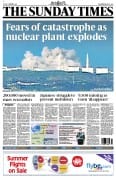
Clearly, the pictures of the reactor building's side walls and ceiling exploding that we all saw live on TV were startling. But it was obviously not a nuclear explosion. As Malcolm Grimston, associate fellow at Chatham House in London, remarked:
"Thankfully, although the explosion was spectacular, it wasn’t devastating and it seems the force was not sufficient to breach the reactor’s metal shell."
Of course, the authorities in Japan rightly evacuated around 170 000 people from a twenty kilometer radius from the plant.
But that was a precautionary move, not one born out of panic. There was some mildly radioactive steam and or hydrogen that needed venting from the plant. It was wise to remove people from its vicinity while the gas dispersed harmlessly into the atmosphere.
To put all this in perspective, the authorities have rated the incident so far at 4 on the 0-7 international scale of severity. The 1986 Chernobyl disaster was rated 7, with the official death toll being just under 50, though as many as 4,000 could die eventually as a consequence of that accident. The 1979 Three Mile Island accident was rated 5. Notably in that case nobody was killed or seriously injured, and no long term health consequences are expected.
Sure, the recent earthquake and Tsunami have pushed the safety defences at Fukushima to the limit. We don't know yet whether the two troubled reactor cores at Fukushima "merely" suffered fuel damage, a partial meltdown or the near full meltdown that occurred at Three Mile Island. But we can say with some certainty that that lack of knowledge is not that important. It took years before we knew the full extent of the meltdown at Three Mile Island. That's because it is not possible to poke one's head, or even a camera, into the reactor core until it cools down and the radiation levels allow it.
There is something very credible and laudable about Japan's safety-first nuclear culture at work in Fukushima. They have flooded their reactors with seawater - which effectively destroys them - to make 100% sure that they cool down harmlessly; the main threat being hydrogen and steam explosions caused by the reactor's heat.
The picture emerging from Fukushima is "reassuring". The onsite and offsite consequences - no deaths and just a few injuries and some dispersal of mildly radioactive gas - have been limited. That's what a safety case and the regulatory authorities demand from a nuclear plant's in-depth multi-layered defences.
It is my view, that the Japanese handling of this nuclear incident at Fukushima - whether they made mistakes or not - will validate the safety case for old nukes.
So there's something very skewed, overblown even, about the media's reporting on Japan's earthquake and Tsunami disasters: we know there are tens of thousands of people dead, hundreds of thousands more homeless or stranded, yet everybody is talking excessively about a troubled nuclear plant that has not and most likely will not kill anybody.
However the media were playing up to stereotypes over Japan's nuclear troubles. There's a rich history associated with nuclear scaremongering, not least because the public has an appetite for horror stories. At Three Mile Island in 1979 the meltdown occurred at the outset of the shutdown. The media and politicians then spent weeks terrorizing the world as they speculated about the terrible impact of a meltdown that had been so undramatic that nobody noticed it had happened already with little consequence.
As I have reported extensively on this online review, while Chernobyl was an horrific disaster, it was no where near as bad as the doom-mongers claimed - see herehere and here.
So the western nuclear industry now has a major PR challenge on its hands. The challenge will be to convince the world that core meltdowns do happen and that the evidence shows that they don't matter much (Chernobyl being a unique case). That calls for some straight and upfront risk management communication, one that can show that new nukes are even more reassuringly safe than old ones.
Subscribe to our newsletter.
Become a subscriber receive the latest updates in your inbox.
You might also like
May 12
Chernobyl book review: Manual for Survival: A Chernobyl Guide to the Future by Kate Brown
HBO's dramatisation of the Chernobyl accident was not entirely factually accurate. But it is futile to criticise the entertainment business for this. But we cannot be so charitable toward Kate Brown’s new book Manual for Survival: a Chernobyl Guide to the Future.
9 min read
Nov 17
Energy independence: a misguided pipedream
Obama’s and Romney’s trumpeting of energy-autarchy and energy-efficiency during the election campaign reveals how they lack both the policies to build a better future. The real challenge is not to turn the clock back on the globalisation of oil, but to accelerate the globalisation of gas.
13 min read
Oct 04
How to make blackouts a thing of the past
The key to providing for our energy needs is technological development, not sterile rows about energy sources. This essay by Professor James Woudhuysen, Joe Kaplinsky and Paul Seaman was first published on spiked-online
20 min read
Mar 17
Reset for nuclear PR
The worst case "media-generated scenario" for Fukushima goes on getting worse every day, nevertheless, we ought to be bold. Indeed, dammit, I'll risk being cocky by suggesting some robust messages and talking points in support of nuclear energy.
4 min read
Mar 12
Living and working at Chernobyl, 1995/6
I have selfishly mixed feelings about the discovery of Europe’s best-protected nature reserve surrounding Chernobyl. My joyrides in a speedboat observing the fish, birds, grazing animals and natural shoreline brushed by rushes, trees and beaches, may not be so special in future.