We need to interrogate the usage, misuse and abuse of science by public relations academics; not least because they mostly do so in association with some of our leading practitioners advising clients. It is necessary, therefore, to raise the profile of this debate about science in wider circles.
I have noticed that there's an increasing interest among PR pros in chaos theory. It might be because we're in recession, the result of recent earthquakes and tsunamis, or even the new complexity that social media throws up. But whatever motivates them, here's some insight into why they are misguided.
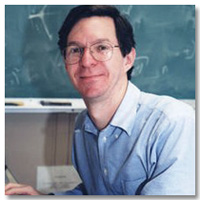
Writing this piece has forced me to reread Norman Levitt (1943 – 2009), professor of Maths at Rutgers. He was among the first warriors to take up cudgels in the Science Wars against left-wing postmodernists in the Academy. He maintained that their social constructivism, epistemic relativism and cognitive pluralism is in reality reductio ad absurdum.
Professor Norman Levitt
Levitt was clearly polemical in style. But he confronted some equally robust opponents. After Levitt died, Professor Steve Fuller, an American sociologist now based at Warwick University, opined that Levitt had been a pioneer of "cyber-fascism". Fuller accused Levitt of having lived in a parallel universe, in which he positioned postmodernists as playing the role of Jews in need of extermination. Sticking the knife deeper in the man's corpse, he said that Levitt's major contribution to the debate was a steady stream of invective. He added that Levitt's robust defence of science was merely the noise made by a loser who felt disenfranchised from the mainstream. So this debate was not nice or polite or for softies.
Of course, what should be remembered is that Fuller blamed Levitt for being behind the Sokal Affair. This, for those new to this stuff, refers to Alan Sokal, a physics professor at New York University, who wrote Transgressing the Boundaries: Towards a Transformative Hermeneutics of Quantum Gravityfor an academic journal devoted to postmodern cultural studies. It was full of intentional howlers, such as claiming that quantum gravity was a social linguistic construction.
The resulting furore was a major embarrassment to the journal Social Text, which published Sokal's baloney in its special edition devoted to what it dubbed the Science Wars. Professor Fuller was especially outraged because he had one of his own papers in the same edition of the journal. The Sokal Hoax seemed to underscore Levitt's argument that for narrow-minded reasons, ignorant left-wing academics wrote and published nonsense about science.
Professor Alan Sokal
In reality this was much more than a squabble between left- and right-wing thinkers. Levitt was actually on the left of the political spectrum as are Professors Fuller and Sokal. For example, Levitt and Sokal, unlike Fuller, had no time for American conservatives who wanted to teach intelligent design in schools as part of the science curriculum. Sokal and Levitt shared a distaste for the left-wing Derridean deconstructionism, which they decried as fashionable poststructuralist drivel, which Fuller admires. So what really united the likes of Levitt and Sokal and split them apart from Fuller was their understanding of the essence of science. In contrast to the postmodernists they stated that there was no such thing as "left-wing science", no more than there was such a thing as "right-wing science" or "feminist Algebra" (no, I didn't make that last one up and neither did Levitt).
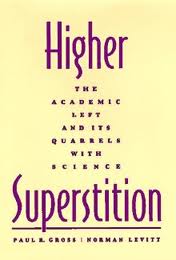
Their concern was that postmodernist academics promoted a disdain for scientific principles, which struck at the heart of what science was about. They argued that this had negative consequences for society at large because it spread distrust about science, scientists and the benefits of the Enlightenment. They accused left-wing academics of promoting, what Levitt called, muddle-headedness:
Higher Superstition: The Academic Left and its Quarrels With Science,
Levitt robustly defended the integrity of scientific works which had been misunderstood and misrepresented by postmodernists. One example of this was Thomas Kuhn's The Structure of Scientific Revolutions, which was denounced by Professor Fuller as a Cold War narrative. In his book on Thomas Kuhn, Fuller even goes as far as to say that Kuhn's work helped dupe scientists into supporting Western militarism in the fight against Soviet and Chinese communism. In short, Fuller's representation of science leans toward explaining it as little more than a conspiracy organised by the Establishment.
For sure, when Levitt criticised postmodernism he fully understood that how scientific knowledge was used was indeed a social and political issue. What concerned him, however, was the suggestion that scientific methodologies and theorizing itself was a social (subjective) construction that produced little more than metaphors. Levitt said repeatedly, mathematical equations are anything but metaphors. He rightly pointed out that mathematics and science have a substance and complexity, which metaphors can't really capture.
So, that's enough background. Now let's take a step closer to understanding what might be attracting PRs to take a serious look at chaos theory. One of the great attractions of chaos theory to social theorists, and in PR to critics of Jim Grunig's work, is its emphasis on the importance of nonlinear mathematical and scientific enquiry in its search for patterns and associations in seemingly complex and chaotic systems. But what I'm not putting under the microscope today is chaos theory in its scientific incarnation. I'm questioning how chaos theory has been exploited for other purposes by people with no understanding of, or respect for, scientific methods.
Chaos theory appealed to social scientists of a particular type because it appeared to provide scientifically-sourced ammunition in support of cultural relativism. As one reviewer of Levitt's work puts it:
To cultural theorists, the word 'linear' represents relentless sequentiality, single mindedness and the triumph of the instrumental -- all components of the supposed Western ethos of conquest, domination and objectification. 'Nonlinear', on the other hand, for them suggests many-sidedness, multi-culturalism, polymorphism and the effacement of traditional disciplines -- a world where multiplicity reigns in culture, sexuality and ethnicity and where old barriers may be freely crossed.
In books such as Katherine Hayles' Chaos Boundit was argued that Newtonian thinking had been overthrown, when in fact it had been subsumed, which, as Levitt said repeatedly, is something completely different. Hayles - in common with many other postmodernists - popularised the fallacy that Newtonian physics was mechanical and linear in its fundamentals. In fact, as Levitt pointed out, Newton's laws of celestial mechanics and his equations of planetary motion are nonlinear to their core.
Levitt's critique of Hayles' book cites her poor grasp of basic scientific principles. On virtually every subject she discussed from Newtonian science, quantum mechanics, logical positivism, to the special theory of relativity, right through to her understanding of mathematics, Levitt found fundamental errors.
Just how ridiculous this postmodernist muddling of maths, science and culture can get is illustrated by Sandra Harding's The Science Question in Feminism, which condemned Newton's Principia Mathematica for being a "rape manual".
So the red lights started flashing when I started reading Priscilla Murphy's influential paper Chaos Theory as a Model for Managing Issues and Crises. My pen-friend Heather Yaxley had already informed me that Murphy's critique of Jim Grunig's two-way symmetric model had been partly responsible for persuading him to rejig it as a mixed-motive model that took more account of asymmetric reality. To my despair I quickly discovered that Murphy's understanding of chaos theory was firmly rooted in Hayles' Chaos Bound. For instance, Murphy makes the following observation:
Her mistake, besides not understanding science, was to ever have supposed that our understanding of the human world could be built around what Newton and Einstein and others discovered about the material world. And just to illustrate how gross errors of reasoning and understanding get repeated, here's Murphy repeating Hayles' fallacy uncritically:
The problem here is that science itself is being accused of being little more than a subjective, social construction. The charge is that science has little to no claim to objectivity. Accepting such premises would make dismissing Global Warming easy and dismissing Creationism and defending Darwin difficult.
One of my points today is merely that when PRs try to wrap their crisis management expertise and their cultural insights in the language of chaos theory and complexity theory (which also interests Priscilla Murphy) they are undermining our trade's reputation.
Of course, there is much more to say on this subject. That brings me closer to what's going to become my core proposition; one which I shall highlight by interrogating the thoughts of some leading PR academics. For example, in the near future I intend to review Jim Macnamara's The 21st Century Media (R)evolution in which, Richard Bailey reports, he writes:
Emergent media owe as much to chaos theory as to evolutionary systems theory.
For reasons that I hope are becoming clear in this piece, Macnamara is wrong on both points. Amusingly, in the same post on his blog Bailey quotes from Martin Thomas' new book Loose: The Future of Business is Letting Go, in which he analyses the chaos and ambiguity of modern life. Thomas is quoted saying, perceptively in my view, that:
We are witnessing the unravelling of the most fundamental building blocks of the commercial world and a collapse of faith in tight, empirical rational models and ways of thinking.
Bailey also mentions how Grunig and Hunt'sManaging Public Relations drew on systems theory. Bailey adds that systems theory once seemed as solid as Newtonian physics - until some new theories came along (Relativity, String Theory) to change the way we think about the world. But Newtonian physics, remains as solid and as relevant and as scientifically robust as in Newton's day: see here for a layperson's explanation of my point. Moreover, the eclectic "systems theory" Grunig drew on had nothing whatever to do with Newton's theories on kinematics and systems, but is an unscientific, wobbly, flexible and elastic construction (see here) drawn from the world of social sciences, which absurdly tries to wrap itself in the language of the physical sciences in an opportunistic and often hilarious mix and match approach.
Well, if PRs take Fuller, Hayles, Murphy and Macnamara seriously - and I'm not claiming Richard Bailey does just because he quotes some authors - one wonders what it will do for evidence-based PR. Perhaps it means R.I.P. Burson Marsteller?
Indeed, I shall be arguing in my book On Message: Propaganda, persuasion and the PR game that both the linear and nonlinear bods in PR circles fail to bring science to their cause. I shall explore why Grunig's theory of Excellence has as little right to claim scientific credibility as does the display of ignorance that emanates from his opponents in the asymmetrical, relativististic postmodernist camp.
So, let's remain grounded. The good news is that chaos and complexity theories, postmodernism and Jim Grunig's symmetrical model of Excellence, have very little to do with proper PR. Thankfully, most PR professionals in the real world don't consider such theories as being relevant. Discussions about what it all amounts to for PR professionals remain marginalized among PR academics and a few practitioners they educated or have influenced. However, if we left it at that that would require conceding the high ground to the spreaders of hogwash.
So in conclusion, I maintain that we need to interrogate the usage and possible misuse and abuse of real science by PR academics; not least because they mostly do so in the name of PR and often in association with some of our leading practitioners. It is necessary, therefore, to raise the profile of this debate about science within the PR community and in wider circles still. I hope you agree.
Recommended further reading:
Here are some links to what my fellow PR bloggers have had to say about chaos theory recently herehere and here
Harmke Kammingen, What is This Thing called Chaos? New Left Review, 1990 (Kammingen writes "...claim that chaos theory is the new paradigm for science should, at least at this stage, be viewed with considerable caution.")
Note: since this was first published in June 2011 it has been updated to take account of the useful criticism Heather Yaxley made of my conclusion (see remarks in comments). It also corrects my understanding of Martin Thomas' quote, which again is a criticism captured in the comments below. I have also incorporated a few other changes. Not least one from Professor James Woudhuysen who set me straight about one of my loose remarks on Newton. Of course, any remaining errors or points of contention remain entirely my responsibility.
Subscribe to our newsletter.
Become a subscriber receive the latest updates in your inbox.
You might also like
May 21
Media's lost art of public debate keeps Trump in power
Howard Kurtz, former Washington Post columnist, says the woke mainstream media let President Trump off the hook in his first term because they dodged debate and indulged in invective and hate. Here I review Kurtz's book 'Media Madness: Donald Trump, the Press, and the War over the Truth'.
6 min read
Dec 17
Give a big fat no to the concept of unconscious bias
The concept of unconscious bias suggests that an audience's supposedly irrational viewpoints require a psychological solution to a pathological condition. This is a useful prejudice when campaigners, corporations and governments find persuasion, even when using their best arguments, ineffective.
7 min read
Sep 08
Opinion piece on the demise of Bell Pottinger
Regardless of the strength or sustainability of a client's messaging, every client, even an oligarch or dictator, is entitled to pay someone to formulate them in the best possible light. Whatever the client or issue a PR tackles, though, telling lies and resorting to deception is not acceptable.
3 min read
Aug 11
How Sundar Pichai perpetuates stereotypical myths about women
Google CEO Sundar Pichai's memo entitled 'Our words matter' claims if a man employed by the company writes or says something women find offensive regarding their gender, Google's women start 'hurting' and 'worrying' every time they enter a room or open their mouth to speak. How patronising is that?
3 min read
Aug 08
Google is wrong to shut down debate about diversity
A Google employee who wrote a controversial memo, which accused the "don't be evil" employer of “silencing” views and creating an authoritarian “ideological echo chamber”, has had his points proven by getting fired.